Immature eagle molting pattern
Posted by NewMexiKen on
URL: http://bald-eagles-of-broward-county-florida.17.s1.nabble.com/Immature-eagle-molting-pattern-tp3090482.html
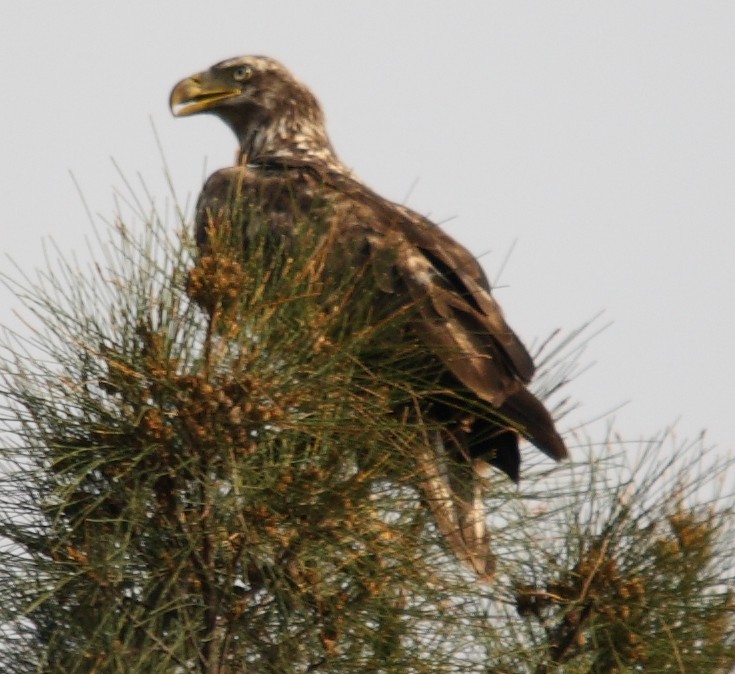
Several times now, immature eagles have been sighted in the area of the nest. In one instance Tom Mitchell captured this shot of a "stranger" actually visiting the nest tree. We could tell by its plumage that this bird was older-- it had more white feathers showing on its head and tail, and its eyes were beginning to turn yellow. It was probably entering its third year. Might it have been last year's chick ("P. Piney One"), who fledged in late March or early April of 2008? With Tom's permission, here is a cropped image of that bird, which he photographed on May 11th:
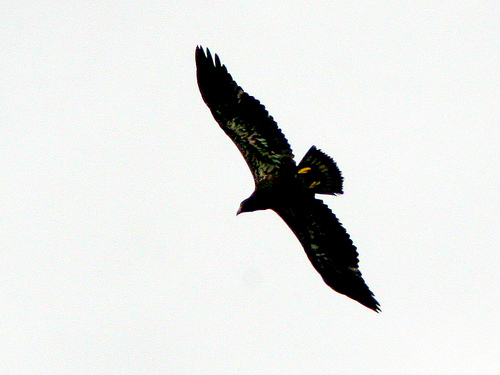
Only yesterday, Mary Lou and I were thrilled to see our second Bald Eagle at Nelson Lake since arriving in Illinois on June 3. The first we saw was an adult, but this one was an immature, probably entering its second year. It is undergoing a molt, very likely changing from its first (juvenal -- not "juvenile") plumage, which is largely very dark (dark body and flight feathers but with mottled white underwing linings), into its first stage of definitive plumage, where white shows up in the flight and tail feathers. Note that the juvenal flight and tail feathers are an inch or so longer than those of an adult eagle, an adaptation that actually makes the youngster appear larger than an adult, but also provides more lift as it tries its wings for the first time. Of interest is the fact that the feathers are shed in small groups symmetrically, so that the wing always remains balanced, and flight is not impaired. By convention, the primary feathers are numbered from nearest to the body, starting with P1, which is the first long feather after the row of secondaries closest to the body. I can count 12 or 13 primary feathers in this photo. The three new new feathers on each wing appear to be P4, P5, and P6. The new feathers are nicely rounded, while the older and longer ones are more pointed and irregular, signs of wear and tear. This feature is particularly noticeable on the tail feathers.
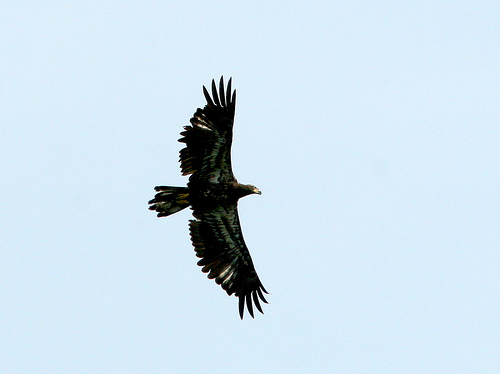
Contrast this with my photo of one of our PP adults in flight, taken Feb 3, 2009-- note the narrower appearance of the wings:
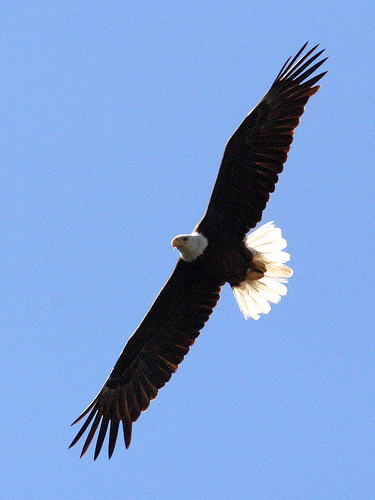
Here is a shot of Hope in flight, on April 6, showing off her nice new flight feathers with rounded ends:
The nomenclature for the various molts and plumages of birds that take more than a year to attain full adult breeding plumage is in some flux. As you know, the full white head and tail of the Bald Eagle take 4 to 5 years to develop.
For an older, but interesting illustrated article on Bald Eagle plumage changes, see this:
http://elibrary.unm.edu/sora/Wilson/v101n01/p0001-p0010.pdf
URL: http://bald-eagles-of-broward-county-florida.17.s1.nabble.com/Immature-eagle-molting-pattern-tp3090482.html
Several times now, immature eagles have been sighted in the area of the nest. In one instance Tom Mitchell captured this shot of a "stranger" actually visiting the nest tree. We could tell by its plumage that this bird was older-- it had more white feathers showing on its head and tail, and its eyes were beginning to turn yellow. It was probably entering its third year. Might it have been last year's chick ("P. Piney One"), who fledged in late March or early April of 2008? With Tom's permission, here is a cropped image of that bird, which he photographed on May 11th:
Only yesterday, Mary Lou and I were thrilled to see our second Bald Eagle at Nelson Lake since arriving in Illinois on June 3. The first we saw was an adult, but this one was an immature, probably entering its second year. It is undergoing a molt, very likely changing from its first (juvenal -- not "juvenile") plumage, which is largely very dark (dark body and flight feathers but with mottled white underwing linings), into its first stage of definitive plumage, where white shows up in the flight and tail feathers. Note that the juvenal flight and tail feathers are an inch or so longer than those of an adult eagle, an adaptation that actually makes the youngster appear larger than an adult, but also provides more lift as it tries its wings for the first time. Of interest is the fact that the feathers are shed in small groups symmetrically, so that the wing always remains balanced, and flight is not impaired. By convention, the primary feathers are numbered from nearest to the body, starting with P1, which is the first long feather after the row of secondaries closest to the body. I can count 12 or 13 primary feathers in this photo. The three new new feathers on each wing appear to be P4, P5, and P6. The new feathers are nicely rounded, while the older and longer ones are more pointed and irregular, signs of wear and tear. This feature is particularly noticeable on the tail feathers.
Contrast this with my photo of one of our PP adults in flight, taken Feb 3, 2009-- note the narrower appearance of the wings:
Here is a shot of Hope in flight, on April 6, showing off her nice new flight feathers with rounded ends:
The nomenclature for the various molts and plumages of birds that take more than a year to attain full adult breeding plumage is in some flux. As you know, the full white head and tail of the Bald Eagle take 4 to 5 years to develop.
For an older, but interesting illustrated article on Bald Eagle plumage changes, see this:
http://elibrary.unm.edu/sora/Wilson/v101n01/p0001-p0010.pdf
Ken Schneider
Web site: http://rosyfinch.com
Blog: http://rosy-finch.blogspot.com
Photos: <http://flickr.com/photos/rosyfinch>
Web site: http://rosyfinch.com
Blog: http://rosy-finch.blogspot.com
Photos: <http://flickr.com/photos/rosyfinch>
| Free forum by Nabble | Edit this page |